
Saturday, December 31, 2011
Torrey Pines
San Diego County has a lot of beautiful beaches. If you go south from Carlsbad, you'll find Torrey Pines, a beach and state park with lots of lovely trees and interesting animals. I couldn't take a good enough picture, so here's one from a professional!

Wednesday, December 28, 2011
Carlsbad!
If you ever have the chance to visit Southern California, spare a day or two for sunny Carlsbad, near San Diego.

We saw lots of interesting-looking birds on the beach, as well as some dolphins swimming out in the ocean! The town is lovely too, and makes staying there entertaining as well as beautiful.


We saw lots of interesting-looking birds on the beach, as well as some dolphins swimming out in the ocean! The town is lovely too, and makes staying there entertaining as well as beautiful.

Friday, November 25, 2011
Christmas Lights!
Now that Thanksgiving is over, people in the US are starting to put up their Christmas lights. I was happy when I opened Yahoo! News this morning and saw this:
The Best Places for Christmas Lights in the USA
The 2nd place, Newport Beach, is in Orange County, and is about 20 minutes from my house. I've seen the Christmas lights there, and they are fantastic!
The Best Places for Christmas Lights in the USA
The 2nd place, Newport Beach, is in Orange County, and is about 20 minutes from my house. I've seen the Christmas lights there, and they are fantastic!
Thursday, November 10, 2011
Burrito!
A student asked me for my burrito recipe. Well, here it is!
Ingredients:
Mixed vegetables (I recommend bell peppers and onions, but many people use mushrooms and zucchini too)
Dried black or pinto beans (sold at your local Brazilian store)
Tortillas (sold at Gyomu Super or Costco)
Rice
Olive oil
Spices - cumin, cumin seed, oregano, black pepper, red pepper, salt, garlic
(optional) cheddar or gouda cheese
Steam the rice as usual, but with 1 teaspoon of cumin seeds and 2 cloves of garlic in the water. Add salt and oil to taste.
Cook about 1 cup of the beans, along with 1 teaspoon of cumin (not cumin seed) and 2 cloves of garlic, in a pressure cooker (圧力鍋) until they get very soft. This should take about 45 minutes. Add a lot of salt, and about 1 tablespoon of olive oil. The beans should be saltier than the rice.
Fry the vegetables in a frying pan on high heat with oregano, red pepper, and cumin, salt, and a little bit of olive oil. Don't let the vegetables get too soft.
Heat the tortillas in a frying pan one at a time. They should be a little bit brown on the outside, but not crispy.
Melt cheese onto the tortillas if you want to.
Last, wrap the beans, rice, and vegetables into the tortilla. The beans should be on the bottom, and the vegetables on top.
Add salsa or guacamole last. The burrito should be hot, but the salsa or guacamole should be cool.
For the guacamole:
1 red onion
2 ripe avocados
1 ripe tomato
Cilantro (also called fresh coriander, pakchi, 香菜, or coentro)
Vinegar and salt
(optional) Red chili pepper
OR:
Just buy guacamole mix at Kaldi (the import food store at Jusco) and 2 avocados.
First, chop the red onion and tomato for the guacamole into very small pieces.
Scoop out the insides of the avocados and mash them into a paste. Then add the onion and tomato.
Chop a handful of cilantro very fine, and add it to the avocado/onion/tomato mixture.
Sprinkle a little vinegar on top to stop the avocados from turning brown. Add salt and red pepper to taste.
Put the guacamole in the refrigerator and keep it cool.
Enjoy!
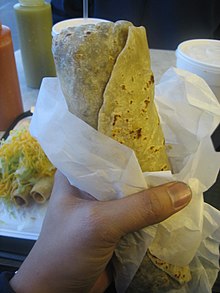
Ingredients:
Mixed vegetables (I recommend bell peppers and onions, but many people use mushrooms and zucchini too)
Dried black or pinto beans (sold at your local Brazilian store)
Tortillas (sold at Gyomu Super or Costco)
Rice
Olive oil
Spices - cumin, cumin seed, oregano, black pepper, red pepper, salt, garlic
(optional) cheddar or gouda cheese
Steam the rice as usual, but with 1 teaspoon of cumin seeds and 2 cloves of garlic in the water. Add salt and oil to taste.
Cook about 1 cup of the beans, along with 1 teaspoon of cumin (not cumin seed) and 2 cloves of garlic, in a pressure cooker (圧力鍋) until they get very soft. This should take about 45 minutes. Add a lot of salt, and about 1 tablespoon of olive oil. The beans should be saltier than the rice.
Fry the vegetables in a frying pan on high heat with oregano, red pepper, and cumin, salt, and a little bit of olive oil. Don't let the vegetables get too soft.
Heat the tortillas in a frying pan one at a time. They should be a little bit brown on the outside, but not crispy.
Melt cheese onto the tortillas if you want to.
Last, wrap the beans, rice, and vegetables into the tortilla. The beans should be on the bottom, and the vegetables on top.
Add salsa or guacamole last. The burrito should be hot, but the salsa or guacamole should be cool.
For the guacamole:
1 red onion
2 ripe avocados
1 ripe tomato
Cilantro (also called fresh coriander, pakchi, 香菜, or coentro)
Vinegar and salt
(optional) Red chili pepper
OR:
Just buy guacamole mix at Kaldi (the import food store at Jusco) and 2 avocados.
First, chop the red onion and tomato for the guacamole into very small pieces.
Scoop out the insides of the avocados and mash them into a paste. Then add the onion and tomato.
Chop a handful of cilantro very fine, and add it to the avocado/onion/tomato mixture.
Sprinkle a little vinegar on top to stop the avocados from turning brown. Add salt and red pepper to taste.
Put the guacamole in the refrigerator and keep it cool.
Enjoy!
Monday, October 10, 2011
The Trouble with Translation part 3
Rice cakes!
Many of my students use this word when talking about mochi. The problem is,
this is what a rice cake is in the USA:

As you can see, it is not at all like mochi. In cases like these, it's much better to explain the thing you want to talk about than to try to use a 1-word translation. Cultures are different, and sometimes the thing you want to talk about just doesn't exist or isn't very well known in another country.
Many of my students use this word when talking about mochi. The problem is,
this is what a rice cake is in the USA:
As you can see, it is not at all like mochi. In cases like these, it's much better to explain the thing you want to talk about than to try to use a 1-word translation. Cultures are different, and sometimes the thing you want to talk about just doesn't exist or isn't very well known in another country.
Thursday, September 8, 2011
The Trouble with Translation, part 2
Last time I wrote about how "cheap" isn't really a good translation of 「安い」. Actually, there are many words that are like those two, but are still taught to English students all across Japan. "A (English) = B (Japanese)" is almost never a good way to approach language learning, but some examples of that type of mistake are more common than others.
Two of the mistaken translations I see most often are "fine = 晴れた" and "fine = 元気". "fine" usually means "good", but can also mean "not great but good enough". It also has a strong connotation of "I don't want to talk about it". If you say "It's a fine day", usually that means there aren't too many clouds, because not many people think a cloudy day is good. However, "fine" is not a description of the weather itself. You wouldn't say, "today it's rainy, but tomorrow it will be fine", for example. Instead, you would say, "today it's rainy, but tomorrow it will be sunny" or "tomorrow it will be clear".
Likewise, when someone asks you "how are you?" and you answer, "I'm fine", you are saying, "good enough". There is a strong implication that you don't want to say any more about it, especially if you say "fine" with a falling intonation. "Fine" is not an especially friendly word. Instead, if you're feeling good, just say "I'm good" or "I'm great". It's OK to be honest!
Two of the mistaken translations I see most often are "fine = 晴れた" and "fine = 元気". "fine" usually means "good", but can also mean "not great but good enough". It also has a strong connotation of "I don't want to talk about it". If you say "It's a fine day", usually that means there aren't too many clouds, because not many people think a cloudy day is good. However, "fine" is not a description of the weather itself. You wouldn't say, "today it's rainy, but tomorrow it will be fine", for example. Instead, you would say, "today it's rainy, but tomorrow it will be sunny" or "tomorrow it will be clear".
Likewise, when someone asks you "how are you?" and you answer, "I'm fine", you are saying, "good enough". There is a strong implication that you don't want to say any more about it, especially if you say "fine" with a falling intonation. "Fine" is not an especially friendly word. Instead, if you're feeling good, just say "I'm good" or "I'm great". It's OK to be honest!
Monday, August 1, 2011
The Trouble with Translation 1
Many people, especially beginners, start learning a new language by translating to their first language. This isn't always a bad idea for total beginners, but it often produces mistakes and misunderstandings, so I don't generally recommend it.
For example, take 「安い」 and "cheap". What do you think of when you see the character 「安」? Well, the same character is used in words like 「安心」and「安定」, which makes me think it, in addition to meaning "low-priced", it also means "peaceful" or "comfortable". Well, the English word "cheap" doesn't have those connotations. When I hear the word "cheap", I think "low-quality", "cheating", and "cutting corners". Not exactly positive, is it?
For these reasons, professional salespeople try to avoid using "cheap" to describe their own products, and shoppers who just got a great deal on a Louis Vuitton would probably not describe it as "cheap". They might say it was "a good deal" or, yes, "reasonable".
For example, take 「安い」 and "cheap". What do you think of when you see the character 「安」? Well, the same character is used in words like 「安心」and「安定」, which makes me think it, in addition to meaning "low-priced", it also means "peaceful" or "comfortable". Well, the English word "cheap" doesn't have those connotations. When I hear the word "cheap", I think "low-quality", "cheating", and "cutting corners". Not exactly positive, is it?
For these reasons, professional salespeople try to avoid using "cheap" to describe their own products, and shoppers who just got a great deal on a Louis Vuitton would probably not describe it as "cheap". They might say it was "a good deal" or, yes, "reasonable".
Thursday, July 21, 2011
Coincidence!
Sometimes expressions from one language resemble expressions in another language, even if the languages aren't related.
I thought "two birds with one stone" resembling 「一石二鳥」was just a coincidence. After reading the wikipedia entry here, now I know that 「一石二鳥」is a translation of "two birds with one stone". Wikipedia is wonderful.
I thought "two birds with one stone" resembling 「一石二鳥」was just a coincidence. After reading the wikipedia entry here, now I know that 「一石二鳥」is a translation of "two birds with one stone". Wikipedia is wonderful.
Monday, June 20, 2011
Happy Father's Day!
Coincidentally, one of my best friends from California had his first child (a girl) just yesterday. I'm sure this will be a Father's Day to remember!
Friday, May 20, 2011
California Weather
It's getting close to the rainy season here in Japan. Pretty soon, it'll be rainy almost every day.
People often ask me if there is a rainy season in California. Well, there is no "tsuyu", but there is more rain during certain times of the year. The rainiest time is winter. It doesn't get very cold (only down to 15 degrees celsius during the day), but it rains a lot and that sometimes causes floods.
When you think of winter and summer in Japan, you probably think of a lot of dead, brown plants in winter; and green, lush plants in summer. It's the opposite in southern California - in summer, all the plants die and wither from the dry heat, and in the winter, they grow from all the rain. There are many fires in the summer because the dead plants in the hills burn easily. I prefer winter in California, and spring and autumn in Japan!
People often ask me if there is a rainy season in California. Well, there is no "tsuyu", but there is more rain during certain times of the year. The rainiest time is winter. It doesn't get very cold (only down to 15 degrees celsius during the day), but it rains a lot and that sometimes causes floods.
When you think of winter and summer in Japan, you probably think of a lot of dead, brown plants in winter; and green, lush plants in summer. It's the opposite in southern California - in summer, all the plants die and wither from the dry heat, and in the winter, they grow from all the rain. There are many fires in the summer because the dead plants in the hills burn easily. I prefer winter in California, and spring and autumn in Japan!
Friday, May 6, 2011
Golden Week
Are you enjoying your vacation?
Can you name all the holidays that make up Golden Week? I can... Showa no hi, ... uh... never mind, I can't.
Today (it's still the 5th in the US) is Cinco de Mayo, an important Mexican holiday.

Mexico and the US are neighbors, and there are many Mexican-Americans who celebrate Mexican culture. Cinco de Mayo is a big holiday in the US, too. If you want to learn more about American culture, it might be a good idea to learn a little Mexican culture, too!
Can you name all the holidays that make up Golden Week? I can... Showa no hi, ... uh... never mind, I can't.
Today (it's still the 5th in the US) is Cinco de Mayo, an important Mexican holiday.
Mexico and the US are neighbors, and there are many Mexican-Americans who celebrate Mexican culture. Cinco de Mayo is a big holiday in the US, too. If you want to learn more about American culture, it might be a good idea to learn a little Mexican culture, too!
Thursday, April 28, 2011
Golden Week
We have no class Friday the 29th or Saturday the 30th, and next Tuesday (the 3rd) is off as well. We do have class next Wednesday, Thursday, Friday and Saturday, as usual. Have a nice break, and we'll see you soon!
Saturday, April 23, 2011
Things that are unexpectedly the same, part 4
4. Names of countries
At some point growing up, you learn that the names you use for countries aren't the same as the names those countries use for themselves. I was very surprised when I first learned that Japan, Spain, and Germany all had different names than the ones we used for them.
When I first moved to Japan, I was surprised that people called Spain Supein instead of España. People also call Cuba Kyuuba, like Americans, instead of Cuba (koo-bah), which Cubans call themselves. Did Japan learn these words from Americans? I wonder what Spanish people think about this!
There are some cases where the Japanese word for a country is closer than the American version. Germany, for example, is Deutschland, closer to the Japanese Doitsu than the English Germany. Switzerland, too, is Suisse in French, Suisu in Japanese, but Switzerland in English. I think the Japanese name is closer.
Actually, Japan's name has changed again since then, too. When I was in high school, we learned that Japan was really called Nihon in Japanese, but people usually call it Nippon now.
At some point growing up, you learn that the names you use for countries aren't the same as the names those countries use for themselves. I was very surprised when I first learned that Japan, Spain, and Germany all had different names than the ones we used for them.
When I first moved to Japan, I was surprised that people called Spain Supein instead of España. People also call Cuba Kyuuba, like Americans, instead of Cuba (koo-bah), which Cubans call themselves. Did Japan learn these words from Americans? I wonder what Spanish people think about this!
There are some cases where the Japanese word for a country is closer than the American version. Germany, for example, is Deutschland, closer to the Japanese Doitsu than the English Germany. Switzerland, too, is Suisse in French, Suisu in Japanese, but Switzerland in English. I think the Japanese name is closer.
Actually, Japan's name has changed again since then, too. When I was in high school, we learned that Japan was really called Nihon in Japanese, but people usually call it Nippon now.
Wednesday, April 13, 2011
Things that are unexpectedly the same, part 3
3. Politicians saying silly things after natural disasters
As you have probably read, the mayor of Tokyo, Shintaro Ishihara, said that the recent earthquake and tsunami were "divine punishment" for the selfishness of the Japanese people. Read here from the Guardian, and the Yomiuri.
But he's not the only one!
Many American politicians say things like this after natural disasters. Here's something to get your blood boiling. A popular radio and TV commentator named Glenn Beck agrees with Ishihara!
About other disasters, political and religious leaders have said many things like Ishihara and Beck about everything from hurricanes (like Katrina) to 9-11. A very popular religious leader named Jerry Falwell blamed 9-11 on gays, feminists, and abortionists.
Sometimes the similarities you find between countries are more disappointing than inspiring.
As you have probably read, the mayor of Tokyo, Shintaro Ishihara, said that the recent earthquake and tsunami were "divine punishment" for the selfishness of the Japanese people. Read here from the Guardian, and the Yomiuri.
But he's not the only one!
Many American politicians say things like this after natural disasters. Here's something to get your blood boiling. A popular radio and TV commentator named Glenn Beck agrees with Ishihara!
About other disasters, political and religious leaders have said many things like Ishihara and Beck about everything from hurricanes (like Katrina) to 9-11. A very popular religious leader named Jerry Falwell blamed 9-11 on gays, feminists, and abortionists.
Sometimes the similarities you find between countries are more disappointing than inspiring.
Saturday, April 2, 2011
Things that are unexpectedly the same, Part 2
2. Trends in baby names
What are some of your grandparents' friends' names? What about your parents' friends? What are your friends' names?
Chances are (if your family is Japanese), the first group includes a lot more Chiyokos and Saburos, the second group has more Michikos and 4-syllable names for men, and the last group has a lot of shorter names like Mika and Shota. I haven't done any real research on this, but I have definitely noticed that none of my adults students' names end in -ya, and almost none of the kids' names end in -ko.
In the US, you'll have a very hard time finding anyone under 70 named Gertrude or Walter. A few of my friends' parents were named Linda or Roger, but none of my friends were. My generation had a lot of Jennifers and Mikes, but apparently those are both a bit rare now.
In both the US and Japan, you can get a fairly good idea of how old someone is just from his or her name.
Interestingly, the authors of language textbooks often use names from their own generation when make up characters. My Japanese textbooks were full of characters named Hanako and Taro, and junior high schoolers in Japan read about characters named Steve and Mary - which haven't been popular names in at least 30 years!
The top names for babies in 2010 were Sophia for girls, and Aiden for boys. I've never met a Sophia or an Aiden in my life! I must be getting old.
What are some of your grandparents' friends' names? What about your parents' friends? What are your friends' names?
Chances are (if your family is Japanese), the first group includes a lot more Chiyokos and Saburos, the second group has more Michikos and 4-syllable names for men, and the last group has a lot of shorter names like Mika and Shota. I haven't done any real research on this, but I have definitely noticed that none of my adults students' names end in -ya, and almost none of the kids' names end in -ko.
In the US, you'll have a very hard time finding anyone under 70 named Gertrude or Walter. A few of my friends' parents were named Linda or Roger, but none of my friends were. My generation had a lot of Jennifers and Mikes, but apparently those are both a bit rare now.
In both the US and Japan, you can get a fairly good idea of how old someone is just from his or her name.
Interestingly, the authors of language textbooks often use names from their own generation when make up characters. My Japanese textbooks were full of characters named Hanako and Taro, and junior high schoolers in Japan read about characters named Steve and Mary - which haven't been popular names in at least 30 years!
The top names for babies in 2010 were Sophia for girls, and Aiden for boys. I've never met a Sophia or an Aiden in my life! I must be getting old.
Thursday, March 24, 2011
Things that are unexpectedly the same, Part 1
1. Earthquakes
Japan and California both have a lot of earthquakes. The last earthquake in California that was really scary for me was in 1994.
If you read the article, you can see that although it was a strong earthquake, not too many people died. There was no tsunami, luckily.
Someday I'd like to try living in a place with no earthquakes!
Japan and California both have a lot of earthquakes. The last earthquake in California that was really scary for me was in 1994.
If you read the article, you can see that although it was a strong earthquake, not too many people died. There was no tsunami, luckily.
Someday I'd like to try living in a place with no earthquakes!
Wednesday, March 16, 2011
Another Earthquake...
This time the epicenter was Fujinomiya. The school is OK. Hopefully no one out there is hurt.
Saturday, March 12, 2011
Earthquake
The school was closed yesterday because of the earthquake and power outage. We are OK, though, and hope you all are too.
Friday, February 18, 2011
Things You Can't See in the US, Part 3
3. Teachers called their first names by their students
(Note: I haven't been to school in the US in many years, so this may have changed, as it certainly has in Japan)
Japan has a reputation for being a very strict place, education-wise. That's why I was so surprised to hear my students referring to their teachers at school as "Megumi" or "Hajime", rather than "Mr. ---" or "--- sensei". When I was growing up, we never, ever called our teachers by their first names. The first time I ever called a teacher by his first name was in college, and that professor was a communist, so of course he believed in equality!
Some people in Japan seem to believe that all Americans are on a first-name basis. This is definitely not true. Especially in the case of teachers, you should call them "Mr.", "Ms." or "Mrs." unless they say otherwise. I know of one case where an American teacher visited Fujinomiya and was surprised that she was introduced to people as "Julia", even to children. Her students in the US would never call her "Julia"!
For the record, I go by "Mark" here because I want to avoid the "shut up, listen and take notes" atmosphere of the usual English class in Japan. If everyone called me "Makino-sensei" I'm afraid they would get too passive.
(Note: I haven't been to school in the US in many years, so this may have changed, as it certainly has in Japan)
Japan has a reputation for being a very strict place, education-wise. That's why I was so surprised to hear my students referring to their teachers at school as "Megumi" or "Hajime", rather than "Mr. ---" or "--- sensei". When I was growing up, we never, ever called our teachers by their first names. The first time I ever called a teacher by his first name was in college, and that professor was a communist, so of course he believed in equality!
Some people in Japan seem to believe that all Americans are on a first-name basis. This is definitely not true. Especially in the case of teachers, you should call them "Mr.", "Ms." or "Mrs." unless they say otherwise. I know of one case where an American teacher visited Fujinomiya and was surprised that she was introduced to people as "Julia", even to children. Her students in the US would never call her "Julia"!
For the record, I go by "Mark" here because I want to avoid the "shut up, listen and take notes" atmosphere of the usual English class in Japan. If everyone called me "Makino-sensei" I'm afraid they would get too passive.
Wednesday, January 26, 2011
Things You Can't See in the US, Part 2
2. Fujinomiya yakisoba

You can find regular yakisoba at the supermarket, but not this local, deliciously chewy kind.
Apparently, American soldiers eat a lot of yakisoba when they're stationed in Japan.

You can find regular yakisoba at the supermarket, but not this local, deliciously chewy kind.
Apparently, American soldiers eat a lot of yakisoba when they're stationed in Japan.
Tuesday, January 18, 2011
Things You Can't See in the US, Part 1
1. Anime-style mannequins

It's true that anime and anime culture are popular right now, but the US is still a long way from having mannequins that look like cartoon characters.
I was surprised when I first moved here to see that kids' drawings are also anime-style. I guess that's just the way people draw here!
PS It's possible that someone, somewhere in the US has these. The US is a big place, so I can't guarantee that you'll never see these in the US. I just think it's extremely unlikely.

It's true that anime and anime culture are popular right now, but the US is still a long way from having mannequins that look like cartoon characters.
I was surprised when I first moved here to see that kids' drawings are also anime-style. I guess that's just the way people draw here!
PS It's possible that someone, somewhere in the US has these. The US is a big place, so I can't guarantee that you'll never see these in the US. I just think it's extremely unlikely.
Wednesday, January 5, 2011
Things You Can't See in Japan, Part 5
9. Anna's Hummingbird

A bird that flies like a helicopter, and is (for some reason) named after O.C. English's co-founder. Read more here.
10. Carl's Jr.

Carl's Jr. is a popular fast food hamburger restaurant in Calfornia, and throughout the western half of the US. The corporate headquarters is actually about 10 minutes from my house. As you know, I don't eat a lot of hamburgers... but I do love the bean and cheese burrito at the Green Burrito, which is another restaurant that shares its kitchen, staff, and sales register with Carl's Jr. Carl's Jr. is the #4 most popular fast food burger chain in the US after McDonald's, Burger King, and Wendy's.

A bird that flies like a helicopter, and is (for some reason) named after O.C. English's co-founder. Read more here.
10. Carl's Jr.

Carl's Jr. is a popular fast food hamburger restaurant in Calfornia, and throughout the western half of the US. The corporate headquarters is actually about 10 minutes from my house. As you know, I don't eat a lot of hamburgers... but I do love the bean and cheese burrito at the Green Burrito, which is another restaurant that shares its kitchen, staff, and sales register with Carl's Jr. Carl's Jr. is the #4 most popular fast food burger chain in the US after McDonald's, Burger King, and Wendy's.
Subscribe to:
Posts (Atom)